
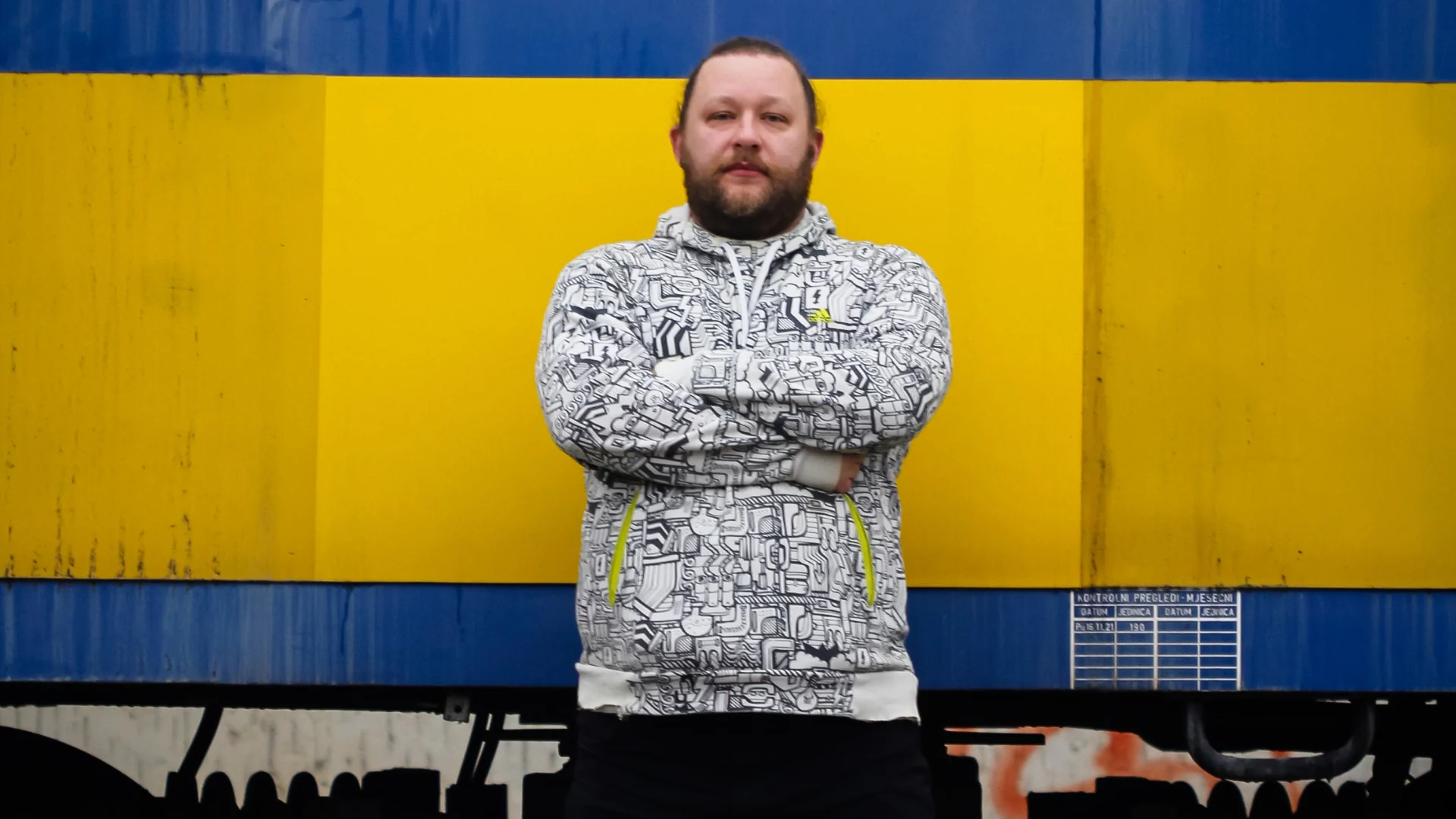

Saša Stević, better known as Fenksta, is one of the most distinctive voices in this year’s Dora lineup. The Umag-born rapper, producer and songwriter, now based in Zagreb, already made a strong impression at Dora last year with his entry “Extra,” standing out for his authentic style and confident stage presence.
In 2026, he returns with “Memento Mori” — a track that blends modern production with a reflective message about time, life and impermanence, showing a deeper and more introspective side of his artistry.
ES: First of all, who is Fenksta, and what does Fenksta mean?
Fenksta: Fenksta is an extra extrovert — that’s a term I coined myself. Because I’m extroverted, but it goes a level beyond that. I come from the city of Umag, where I grew up. I’m currently 36 years old, and my main genre is hip-hop.
Originally, Fenksta doesn’t really mean anything. It started when my best friend made fun of me. In Croatia, there used to be a stereotype that anyone who makes rap music has to be a gangster — play basketball, smoke weed, the whole nine yards thing. So someone said, “He’s a gangsta.” And my friend replied, “No, he’s Fenksta.” Everybody kept asking what it meant. Nobody understood anything, so I said, “I guess I’ll take it.”
ES: So it’s something like a fake gangsta?
Fenksta: Yeah, that’s the closest explanation. It just popped into my head, it was funny, unique, and it didn’t mean anything — perfect!
⸻
ES: Last year, you were a second reserve with your song “Extra”. This year, you got into Dora directly. How was the moment you found out? Did you expect it?
Fenksta: You know what? This is going to sound cocky, but yes, I expected it. But only because I believed in the song more. I knew it surpassed the quality of “Extra”.
At the time, I was at work at a new job. I had Instagram open, refreshing the Dora profile like crazy. As soon as the clock hit 12:00, I refreshed, saw my picture, and was like, “Yes!”
What was crazy was how they announced it — just on Instagram. They didn’t call before. Also, they did it much earlier than usual. They said, “Tomorrow big news!” and everyone thought it wouldn’t be the list yet. And then — boom! It was the list. I also found a few other names I know, so I’m happy to hang out with them again.
⸻
ES: Last year, you were singing in Croatian. This year, the song is in English. What is The “Memento Mori” about?
Fenksta: The song is about having FOMO — fear of missing out — about art.
There’s so much music released every single day, so many movies that come out, TV shows, streaming platforms, video games, books. You just don’t have the time to find it all, to experience it all.
The best way would be to stop time, watch a movie, and then continue normally, without losing any time. That was the idea — what if I could stop time to enjoy art?
ES: So you have to use every second of your life?
Fenksta: Yes, absolutely. Use everything you have.
⸻
ES: The song has a positive message with a Latino sound and rap. How did you find this combination? Do you think it could be a winning one?
Fenksta: I definitely believe in it. I am under the impression that I do have a song that can win.
I’ve never been shy about other genres. I’ve already tried different things, like synth-pop, drum and bass, house, nu-metal. So I figured — let’s find a sound I will agree with first. It just happened that I was at karaoke. There were two girls from France who were singing a song by GIMS, and I thought: That’s the sound! That’s the sound I want.
I didn’t know what to do with it, I just knew – that’s the sound I want. But what will I sing about? I knew it had to include singing ’cause throughout last year’s journey, everybody was like: “You should have rapped faster.” “You should have sung.” “You have a beautiful voice.” And I was like: can you just let me make music the way I want to?
So I figured: Let’s combine everything. I made it in English because it should have some international appeal. ‘Cause, statistically, the majority of Eurovision winners, since they got rid of the language rule, were in English.
I know I have to get through the Croatian selection first. So it’s a 50/50 with the language. You can never satisfy everybody. It’s either: you go for the masses, in English, so everybody understands you, or you go in Croatian, embracing the native language, and then see what happens. There’s no formula — you just go with the flow.
⸻
ES: You have the same team as last year. What shall we see on stage at Dora on February 12?
Fenksta: Actually, so it’s gonna be interesting. The costumes aren’t fully done yet because we had to take measurements for everybody. My costume designer made everything bigger on purpose, so we can shorten it later.
I want to use this opportunity to mention her — her artist name is Salicula.
When it comes to performance, the two words we use the most within the team are: luxury Latino. So that’s the vibe I’m going for.
⸻
ES: Why do you think you’d be the perfect choice for Croatia at Eurovision?
Fenksta: I think it’s most important that the person or group that gets selected cares about being at Eurovision. Some people sign up because they think it’s a good opportunity — and it is — I’m not saying people shouldn’t take these opportunities. But as a representative for Eurovision, it should be someone who is a capable artist, has a good song, and love for Eurovision.
⸻
ES: You created a fundraiser. How is it going?
Fenksta: Better than expected! It’s a bit stagnant now because I don’t want to burden people too much, but people have already been very generous in the first few days. The problem is, it’s never gonna be enough. Everything costs a lot of money. It’s not that I have to pay to perform, but if I want to make it amazing, if I want to win, there is some investment needed.
In certain countries, they take a different approach, financially supporting all artists. But there are also fewer artists. But with 24 artists, I imagine it would cost the broadcaster a lot of money. So if, at any point in the future, Dora gets reduced to like ten people, then I see it as a possibility, but for now…
⸻
ES: You’ve lived in several countries and can rap in Croatian and English. Any other languages?
Fenksta: My German is much better than my English. However, since I go to karaoke, I like to try all kinds of languages. The last one that I added to my list was Maltese. But when it comes to rapping, a few years ago, I was a part of the competition on Instagram when one of the challenges was multiple languages, so I contacted a few people I know to have this one verse that was a combination of Swedish, Korean, Hebrew, Portuguese, German, English, Croatian, and Spanish – eight languages in total. It was two sentences of each. I also rap in Spanish, Italian, French, and Neapolitan.
⸻
ES: You were among the 100 fastest rappers in the world, reaching 13 syllables per second. How is that measured?
Fenksta: It’s from 2017. Now I am probably not even in the top 200. But I think I’m in the top 5 in the Balkans, only because not enough people have been measured yet. The way you do it is you take the fastest part of a song, count the syllables, and divide them by seconds — syllables per second.
My record is 13, but I want to break it. Not only my own, but also the Balkan record, which I think is 14 at the moment. In general, with fast rapping, the best languages are Asian languages — especially Tagalog — because of their phonetics.
⸻
ES: You’re a huge Eurovision fan. Why do you like it so much? When did you start following Eurovision?
Fenksta: I don’t know, it just happened. There is so much good music on there. Every country gets to send something else. In the last couple of years, everything has been vastly different. You get Käärijä, who does a combination of heavy metal and rap. Then you have Zdob și Zdub who do folk and ska and punk. Then you get to Alvan and Ahez – they do what I like to call forest rave. Then you get to the Netherlands, which, for some reason, likes country. The amount of different kinds of music, that’s why I like it. Also, the sense of competition, it’s a yearly event; you get together with people, and you rank all the songs. That’s what’s fun about it.
I don’t mind attention or rankings at all. Yesterday I saw myself ranked last and first. If I’m in the top 10, I say thank you. If I’m last — well, what can I do about it? Someone has to be last. I am aware that not everybody likes everything, and they shouldn’t. It would be great, but it would also be boring.
⸻
ES: Which Eurovision songs do you like to sing the most?
Fenksta: That changes. Now, the one I do the most at karaoke is “Milkshake man”. At karaoke, hype songs work best. “Cha Cha Cha” gets the people going. “Mon Amour” works really well. Sometimes “Baila” by Abor and Tina — depending on the day and how my voice is. I’m gonna do covers of this year again. Every year, I use a different format. Last year, I did five songs from Dora and five songs from Eurovision, so God knows what I will do this year. I will wait until Eurovision is over to make my official ranking, and then I will sing.
⸻
ES: Finally, a message for Eurovision fans?
Fenksta: The most important thing is: enjoy the music, enjoy the artists. Do not bully the people; they are also people with feelings. When it comes to Dora, vote DORA09 if my song is your favorite. If you don’t, vote for whoever you think is the best.
A lot of negativity online isn’t even from real people — it’s bots, trolls, and fake accounts. So if you see a mean comment, don’t give it attention. Every time you are in the spotlight, there are always people who are unintentionally or intentionally mean; you have to deal with it either way.
As for me, I don’t let negativity affect me. It’s how I generally live my life. One of my friends told me the other day that he admires my what we call, a “not giving a f.ckitus”. It’s just a good quality I have.
About Post Author

