
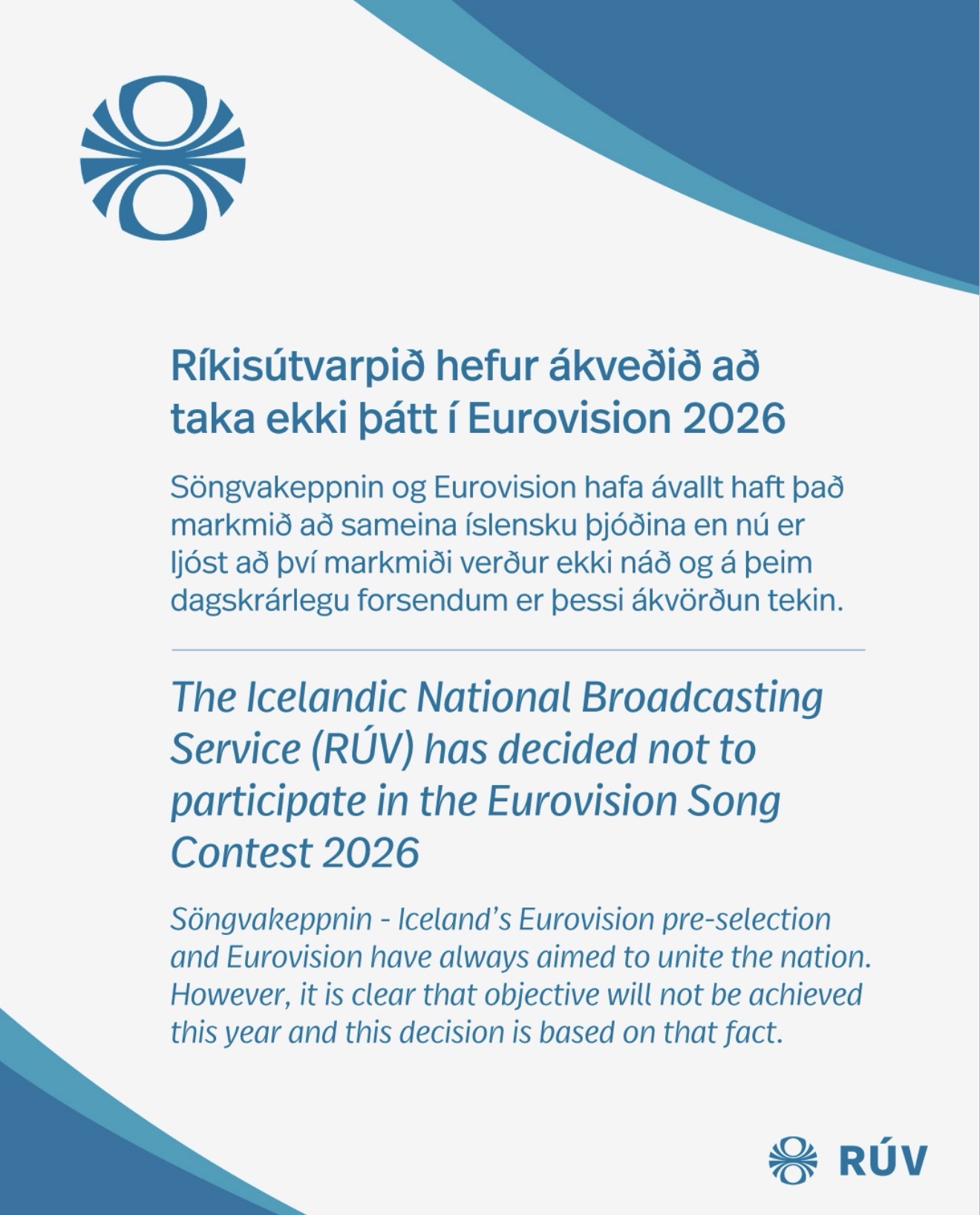
In a significant move, RÚV has announced that Iceland will not participate in the Eurovision Song Contest 2026 in Vienna. The decision, made during a board meeting on December 10, 2025, reflects growing domestic unrest over the participation of KAN, the Israeli national broadcaster.
RÚV’s official statement emphasises that the long-standing goal of the competition — to unite the Icelandic people — cannot be achieved under the current circumstances. “This decision is based on that fact.”
Background: Rising Tensions Over Israel’s Inclusion
The withdrawal follows months of deliberation. Since September 2025, RÚV had indicated participation in Eurovision 2026 was conditional, depending on whether Israel would be allowed to compete.
RÚV’s leadership had raised concerns about both the performance of KAN and the broader political implications of Israel’s inclusion, especially in light of the ongoing war in Gaza. The broadcaster even went as far as recommending to the organizing body, European Broadcasting Union (EBU), that Israel be excluded from the contest entirely.
When the EBU allowed Israel to participate with no vote — opting instead for new rule changes — RÚV’s board concluded that such a decision would provoke division rather than unity among Icelanders.
On the Fate of the National Selection: Söngvakeppnin
Until recently, RÚV had kept the national selection contest, Söngvakeppnin 2026, technically open. Song submissions were accepted, and at one point the deadline was extended in hopes that the EBU discussions might lead to a reversal.
But with the new decision, it is unclear whether Söngvakeppnin will proceed or be cancelled. In their statement, RÚV said that future plans for the national contest are still under review.
Wider Fallout: Iceland Joins Growing Boycott
Iceland is not alone. With this withdrawal, the country joins others — including Spain, the Netherlands, Ireland and Slovenia — who have also announced they will not participate in Eurovision 2026 in protest against Israel’s inclusion.
For many of these broadcasters, the decision stems from ethical and humanitarian concerns regarding the conflict in Gaza and what they see as the political instrumentalization of the contest.
For Iceland, this marks a rare break in a long tradition: the country has participated in almost every edition of Eurovision since debuting in 1986 (save for a few relegation years).
About Post Author
